
Custom Acrylic Table
Share your drawing, reference sample, or required dimensions. We turn it into a controlled acrylic table program covering sampling, bulk production, inspection, packing, and repeat orders.
- We have produced custom acrylic products since 2011. Our customers include furniture brands, wholesalers, designers, hotels, restaurants, and other commercial buyers.
- Our engineering team has factory experience since 2011. It reviews spans, supports, joints, mixed-material interfaces, forming, assembly, and packing.
- The approved acrylic table sample becomes the production reference. It controls material, dimensions, color, construction, hardware, assembly, testing, packing, and repeat-order versions.








Quick specifications
| Item | Details |
|---|---|
| Product Scope | We manufacture coffee, side, console, dining, nesting, and C-shaped designs from your drawings, reference samples, or specified dimensions. |
| MOQ | Standard acrylic table orders can start at 50–200 pieces, depending on the model and order mix. |
| Sample Timing | Sample production typically takes 3–7 days after the design and material details are confirmed. |
| Production Lead Time | Bulk production is scheduled for 10–35 days, depending on order quantity, material availability, and product complexity. |
| Size, Thickness and Load | We can process 5–100 mm acrylic for tabletops, bases, supports, and other furniture components. |
| Material and Finish | Cast acrylic with 92% light transmission is available in clear, smoked grey, tea, milky white, gradient, frosted, and custom-tinted finishes. |
| Assembly and Packing | Each acrylic table pack can include a PE bag, foam separation, foam board, a wooden case, and a pallet. We record assembly and carton details by SKU. |
| Shipping Terms | We provide protective packing and support EXW, FOB, DDU, or DDP delivery according to the schedule agreed in the contract. |
Turn Your Table Design into a Repeatable Production Program
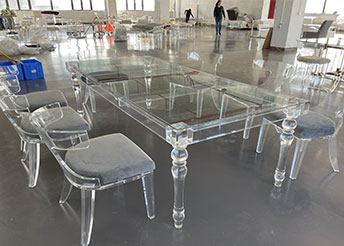
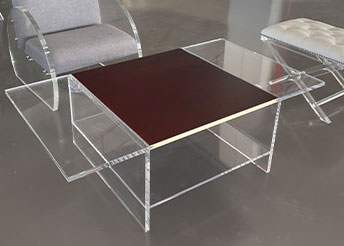
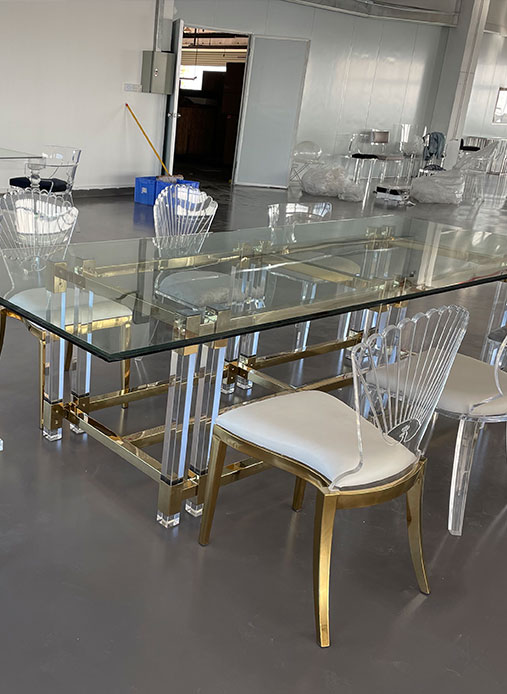
As an acrylic table manufacturer, we start with your design and intended use. We determine whether the project needs a complete table, an acrylic top or base, or a mixed-material assembly. We then review material thickness, unsupported spans, supports, joints, hardware, floor contact, finish, assembly, and packing. We assess each coffee, side, console, dining, nesting, or C-shaped design for its proportions and use. The approved drawing and finished sample become the standard for appearance, stability, component fit, labels, inspection, and future OEM acrylic tables, helping quality teams manage the program consistently.
Our Products
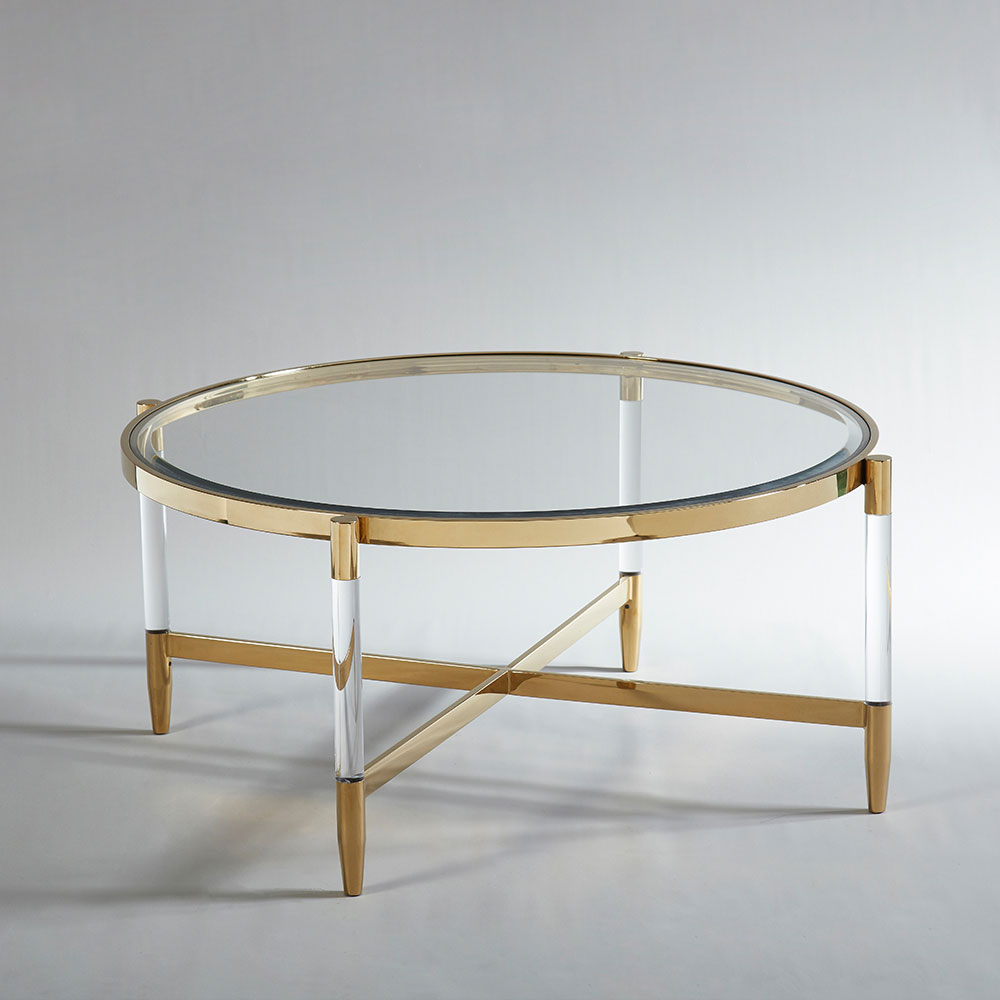
Acrylic Coffee Tables
For an acrylic coffee table, confirm the top footprint, height, and edge finish. Then review leg joints, floor contact, and packing for retail or hospitality use.
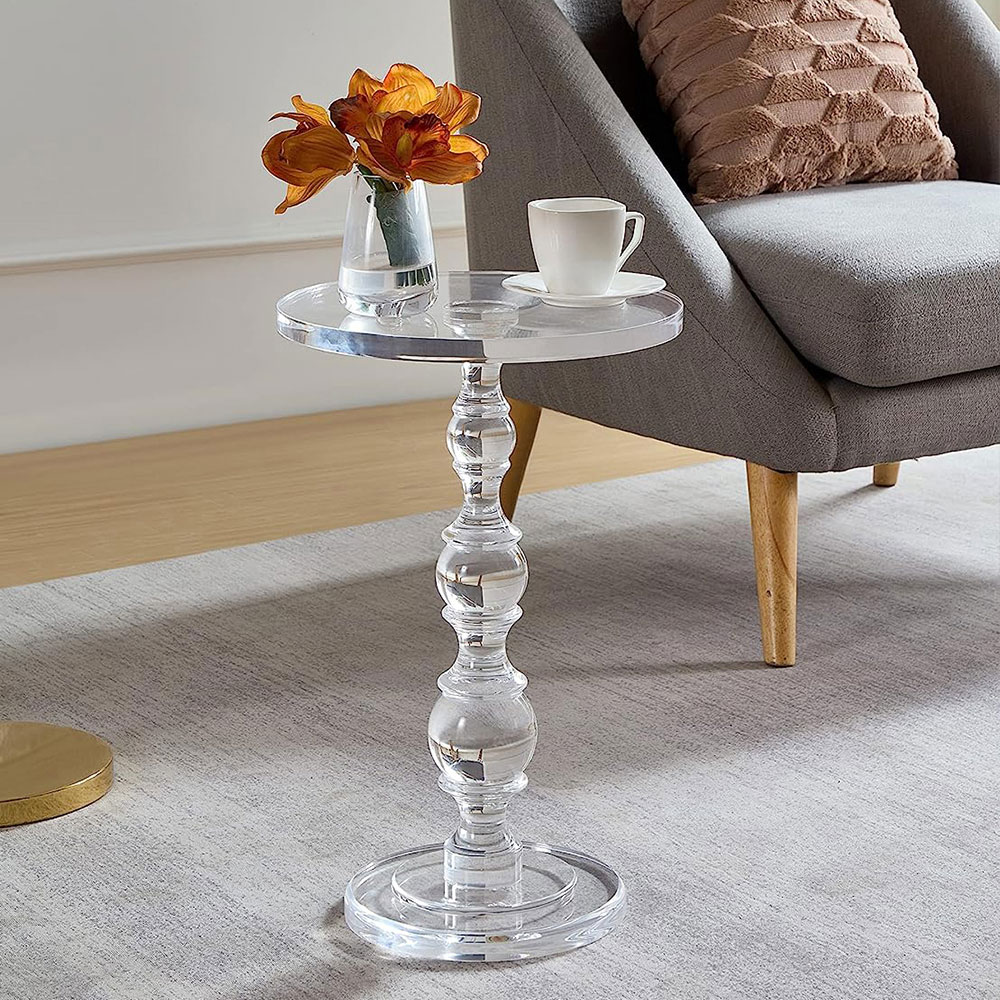
Acrylic Side Tables
For an acrylic side table, define sofa or bed clearance and the usable top area. Then check the base footprint, tipping risk, storage, and carton size.
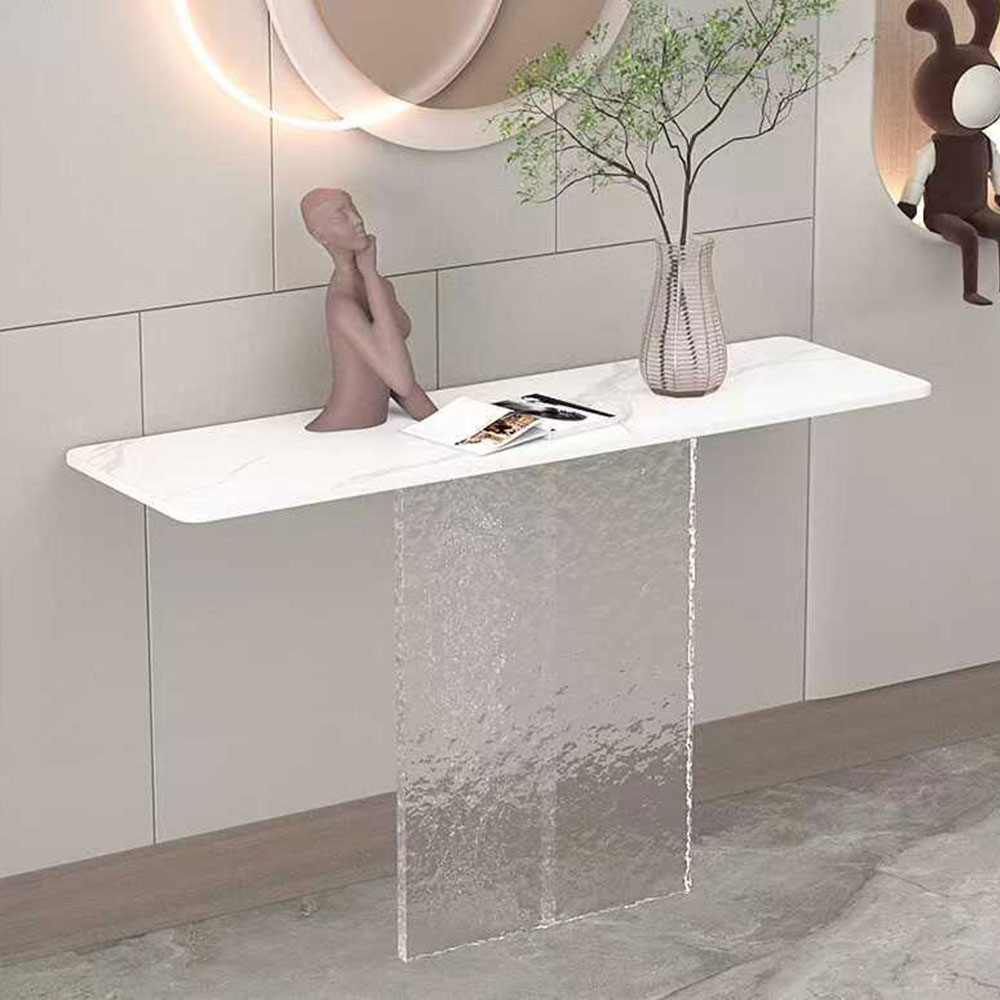
Acrylic Console Tables
For an acrylic console table, confirm the long, narrow proportions and aisle clearance. Then review base stability, floor contact, and any wall-fixing need.
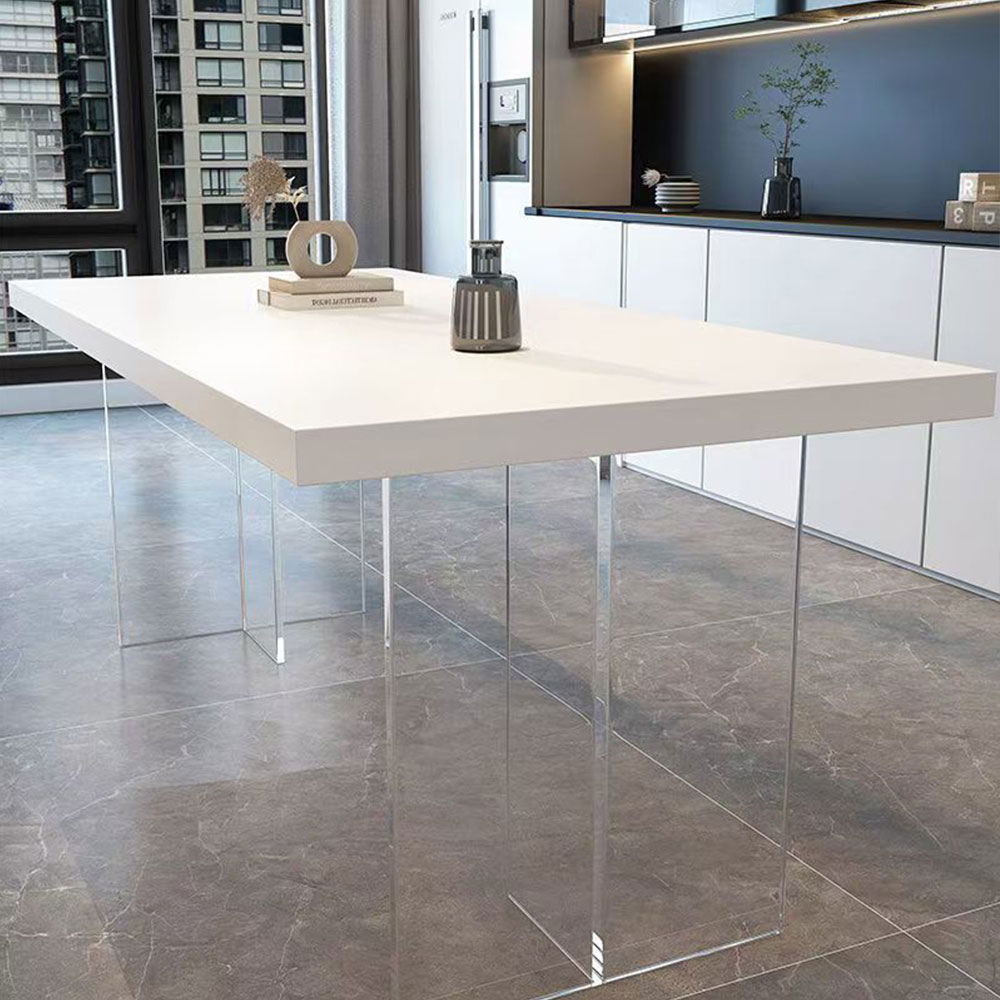
Acrylic Dining Tables
For an acrylic dining table, specify seat count, chair and knee clearance, unsupported spans, base position, floor leveling, and the required test plan.
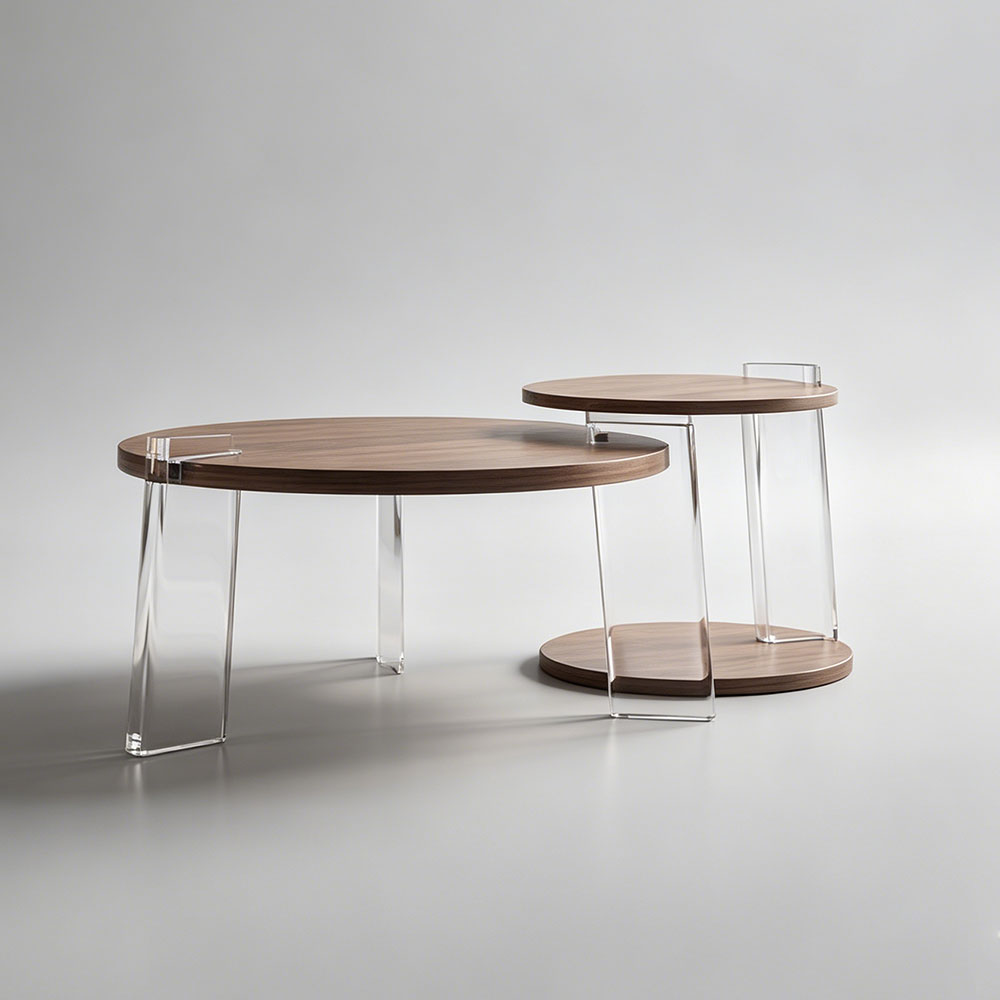
Acrylic Nesting Tables
For acrylic nesting tables, approve the order, overlap, clearances, friction points, separators, pieces per set, and SKU labels before packing.
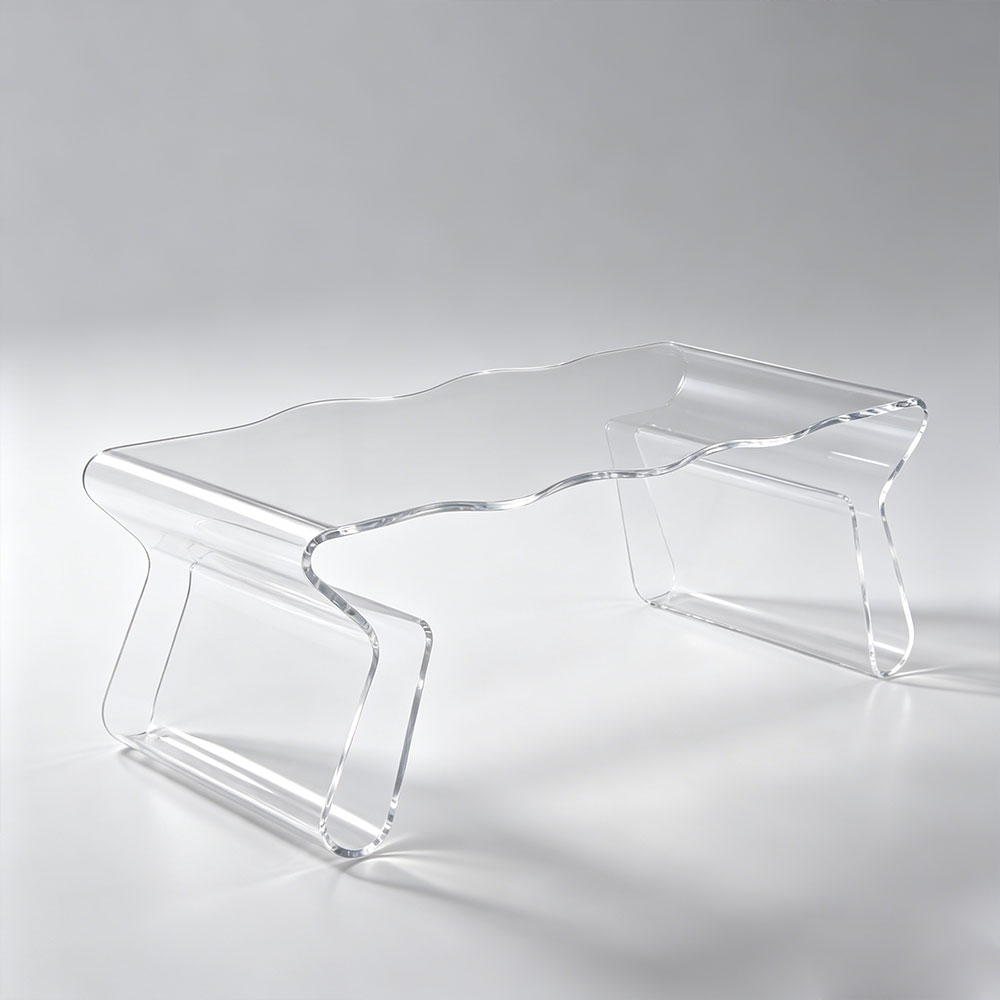
Acrylic C Tables
For an acrylic C table, check the slide-under clearance, top size, base footprint, stability, and floor contact beside the intended seating.
Customization Range
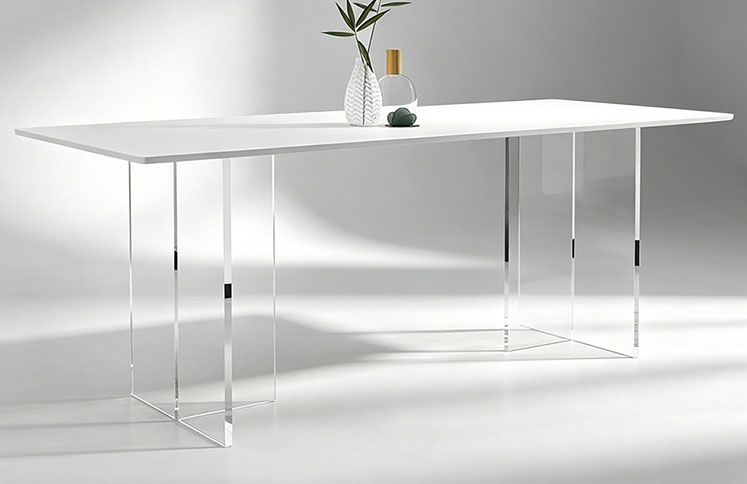
Table Size and Overall Size
For each acrylic table, specify the length, width, height, and top and leg thickness. Also record the footprint, clearances, unsupported spans, support points, and maximum packed size.
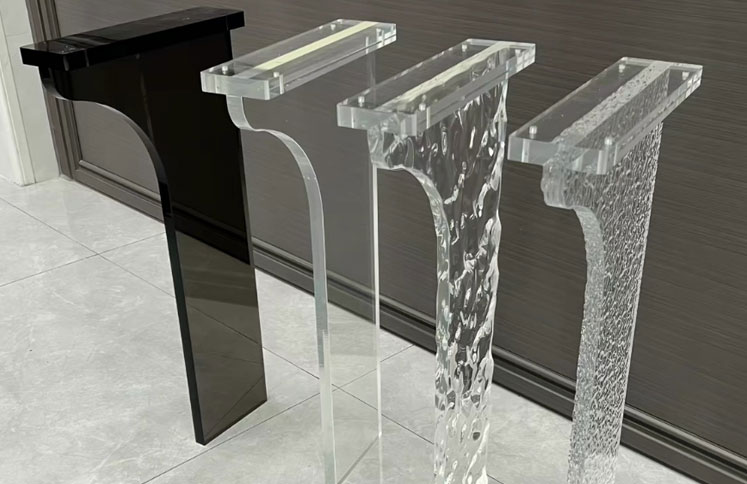
Acrylic Material Type
Define cast or extruded PMMA for each component. Record the grade, thickness, color, transparency, surface, supplier reference, and any mixed materials.
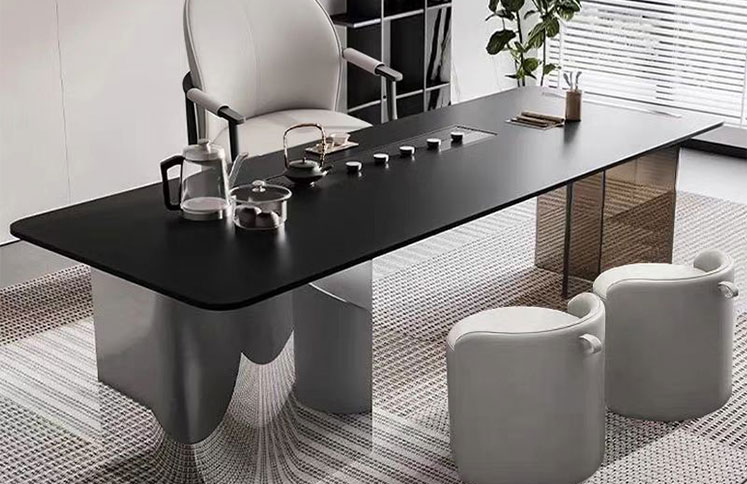
Table Structure and Use
Choose the acrylic table structure and use: coffee, side, dining, console, desk, nesting, bar, conference, assembled, knock-down, modular, or component-only.
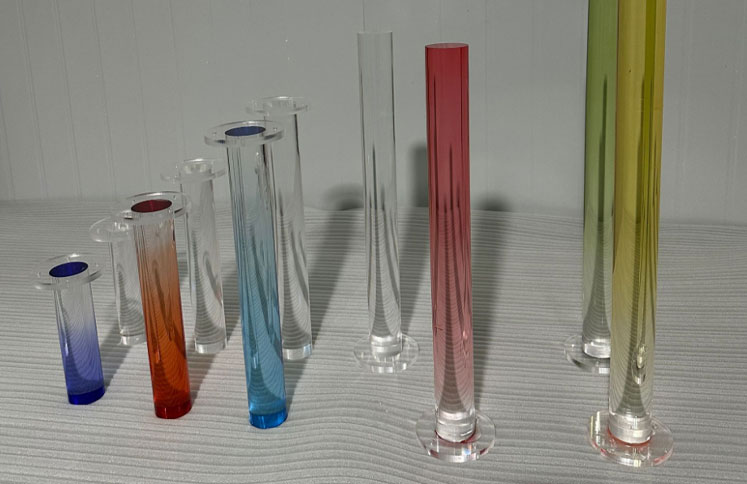
Surface Treatment
Approve clear, smoked, tea, colored, frosted, gradient, sandblasted, printed, engraved, or custom-tinted finishes against a physical reference.
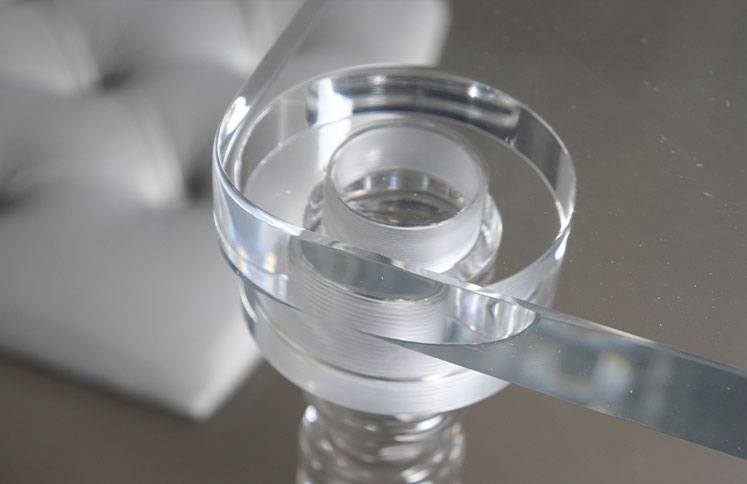
Edge and Corner Finish
Specify polished, matte, rounded, chamfered, radiused, or protected edges and corners for contact, cleaning, aisle safety, and presentation.
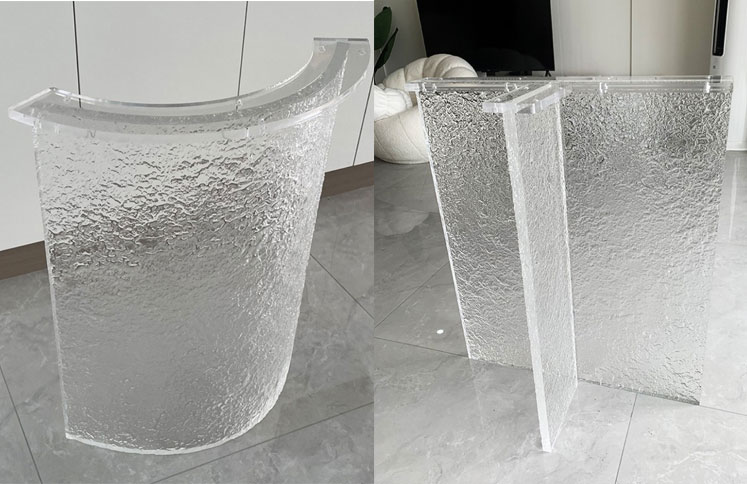
Branding and Personalization
Add laser engraving, screen printing, UV printing, serial numbers, or care labels as needed. Barcodes, SKU marks, and private-label packaging can support your channel.
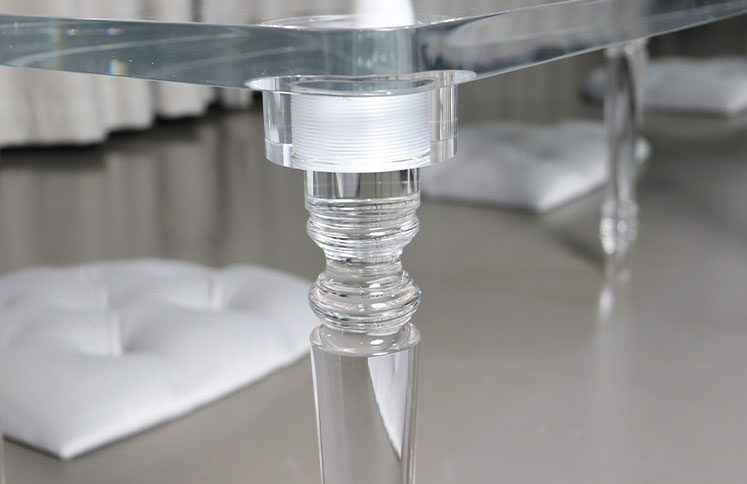
Hardware and Assembly
The approved BOM records inserts, brackets, fasteners, glides, levelers, connectors, tools, and spare parts. It also covers torque notes, third-party interfaces, and assembly instructions.
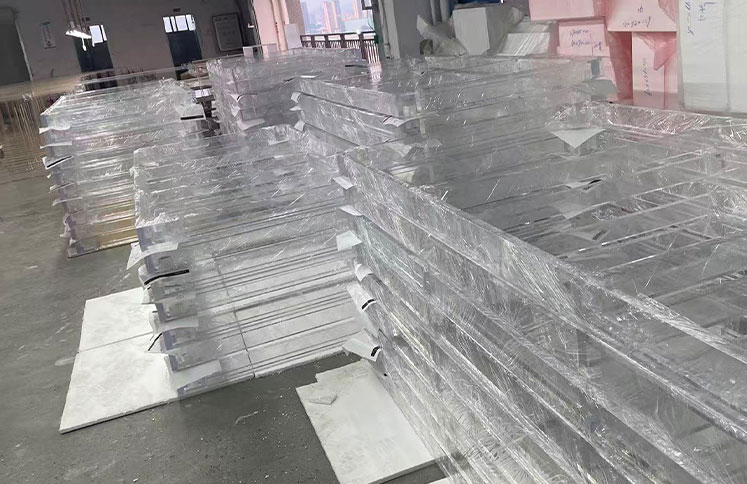
Packaging and Presentation
Choose the acrylic table pack format: assembled, knock-down, modular, or nesting, with surface separators, edge protection, hardware bags, cartons, cases, pallets, and project labels.
Feature Box
Validate the Structure Before Sample Approval
Before you approve a sample, we review how the table will be used and check its dimensions, unsupported spans, base footprint, support points, material thickness, joints, and floor contact. We then build the sample to the agreed construction and check dimensions, flatness, wobble, tipping, and normal off-center use. This gives your team one acrylic table structure to approve and gives production a clear reference, reducing redesign, repeated sampling, and avoidable delays.
Confirm Mixed-Material Fit Before Bulk Production
When an acrylic base connects to a glass, wood, stone, or metal top, small interface errors can delay installation. Send the drawing or reference part and explain the intended use. We confirm support positions, contact pads, hole locations, inserts, fasteners, and assembly sequence, then trial-assemble the connection before bulk production. Your installation team receives an approved fit, which helps prevent redrilling, forced assembly, mixed hardware, and unnecessary stress around fixing points.
Keep Every SKU Consistent for Receiving and Reorders
Receiving teams need to know which carton, hardware set, and assembly method belong to each SKU. We decide whether the product should ship assembled, knock-down, or nested, then define surface protection, edge protection, hardware bags, carton labels, and the pallet plan. The approved acrylic table drawing, material, color, hardware, packing method, and sample reference stay under the same SKU, helping your warehouse receive the correct version and purchasing teams reorder it with confidence.
Manufacturing Process
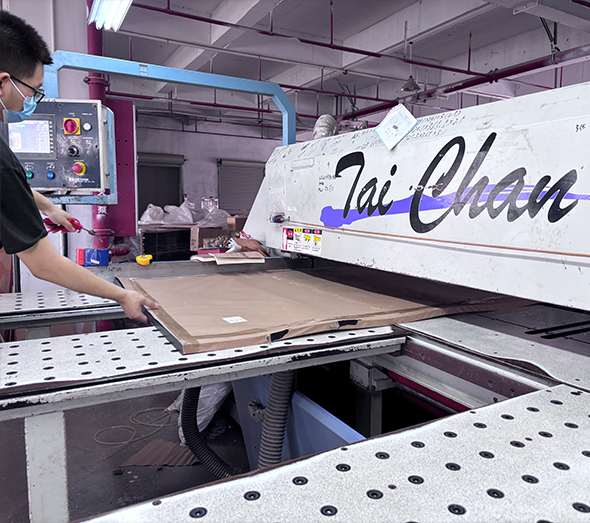
Electronic Saw Cutting
Acrylic table parts, templates, and packing components are cut to the released drawing. Protective film and part identification stay in place.
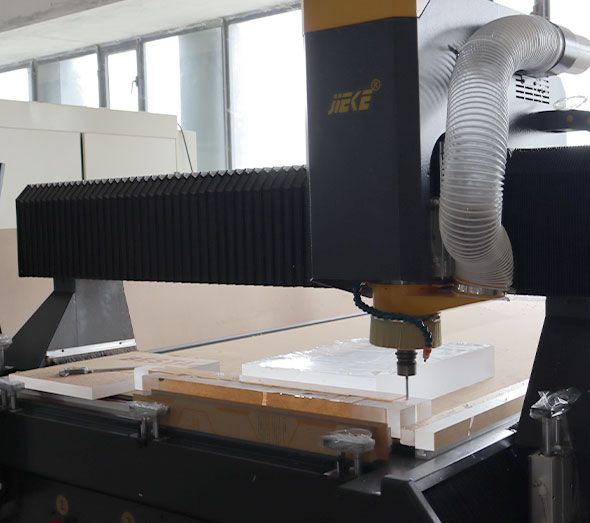
Cutting and CNC Machining
Profiles, holes, slots, pockets, cable openings, inserts, hardware interfaces, and bonding surfaces are machined from the approved production file.
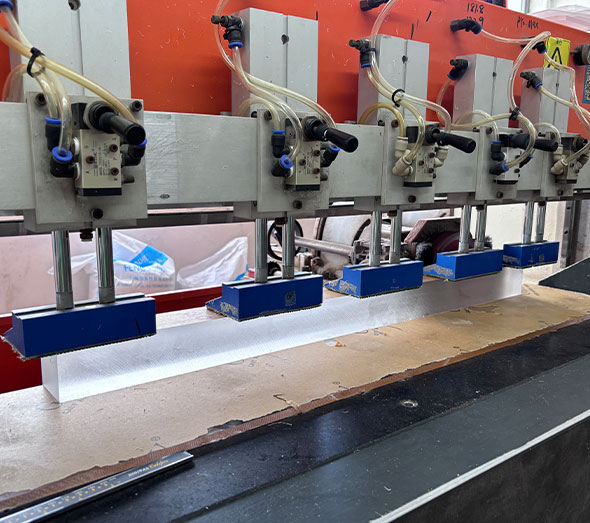
Edge Polishing and Forming
Visible tabletop, leg, base, shelf, and joint edges are ground and diamond polished to remove tool marks before forming or assembly.
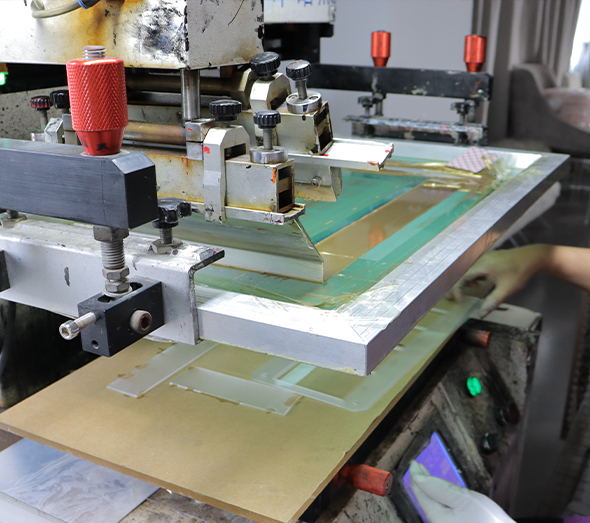
Printing and Engraving
Printing, engraving, serial marks, care labels, and SKU codes follow the approved artwork, position, color, and reading direction.
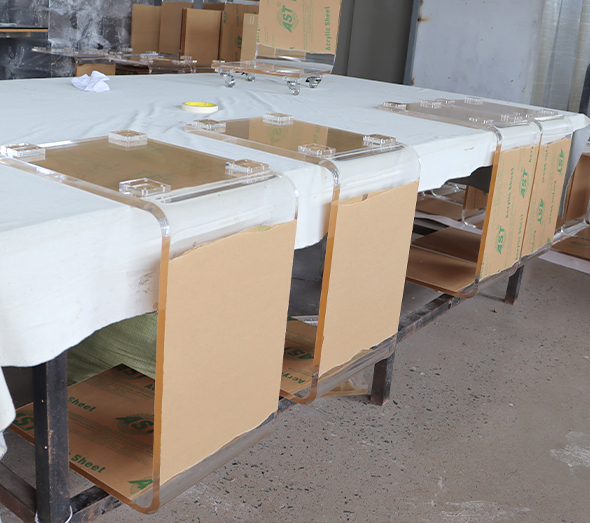
Hot bending
Legs, returns, aprons, shelves, bases, and curved supports are heated and formed to the approved angle, radius, direction, and checking fixture.
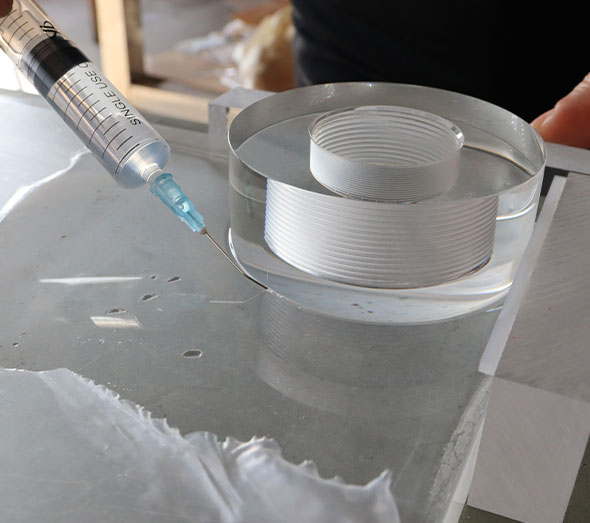
Bonding
During acrylic table assembly, tabletops, legs, supports, reinforcing parts, and mixed-material interfaces remain in fixtures while the approved bonding process sets.
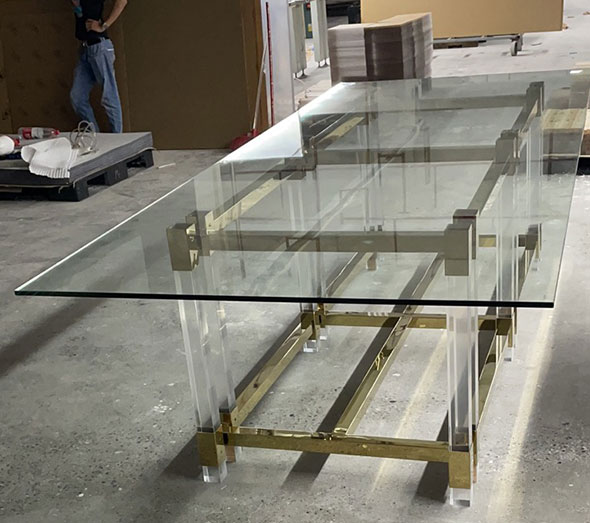
Quality Inspection
Each finished table is checked for dimensions, flatness, stability, surfaces, edges, bends, joints, hardware, assembly, SKU identity, and agreed inspection records.
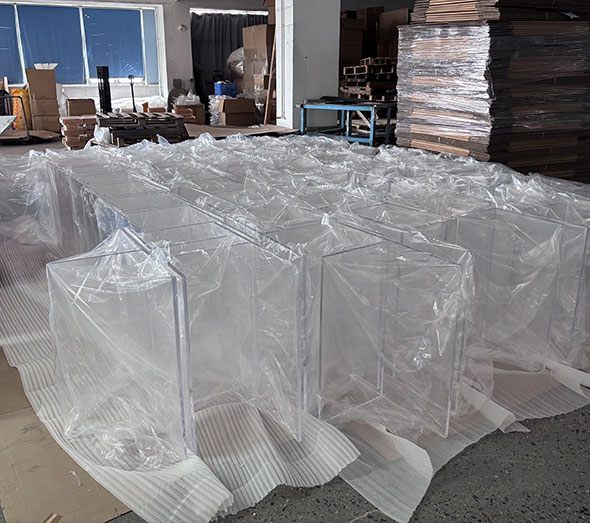
Protective Packing
The approved pack keeps protective film in place and adds separators, edge protection, hardware bags, labels, cartons, wooden cases, or pallets as specified.
Application
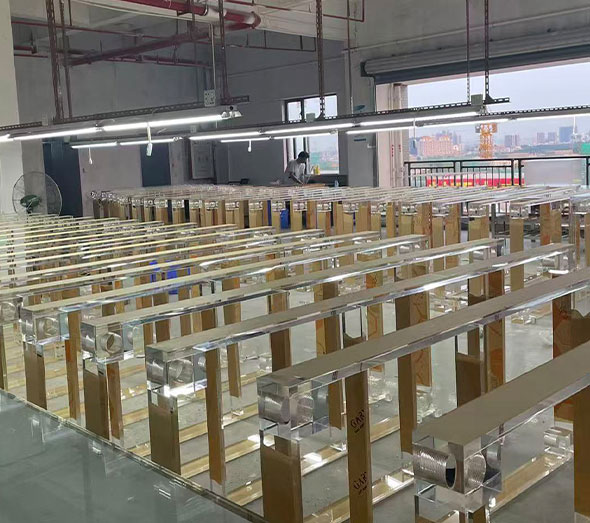
French Interior Design Studio — November 2024 — 40 mm Console Table
Project: In November 2024, a French interior design studio ordered a clear acrylic console table measuring 1220 × 380 × 760 mm from 40 mm acrylic. Challenge: the narrow 380 mm depth made small leg-angle errors visible when the acrylic table stood against a straight lobby wall. Solution: JFM machined the top and two sides from one coordinate reference, bonded the joints in a full-size squaring fixture, and checked both diagonals before final polishing. Result: the completed acrylic table kept its two legs parallel within 1.5 mm, the top-level difference stayed below 2 mm across 1220 mm, and the wall-side edge followed the approved line without a visible step at either joint.
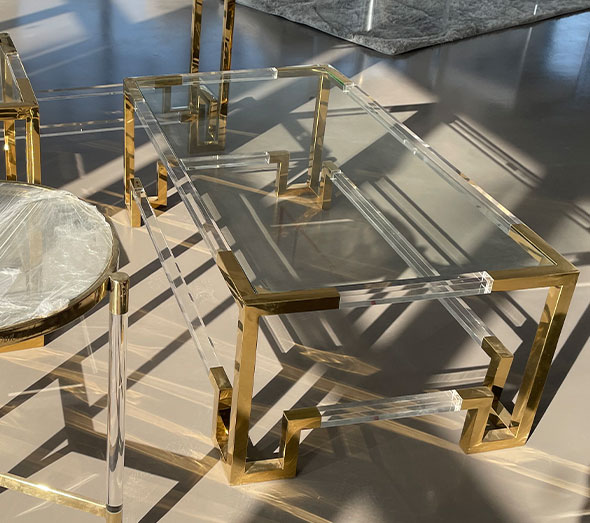
United States Furniture Brand — July 2025 — Reinforced Coffee Table
Project: In July 2025, a furniture brand in the United States ordered an acrylic coffee table measuring 1200 × 800 × 400 mm with a 30 mm top and 25 mm clear legs. Challenge: the wide acrylic table needed clean visible joints, but corner pressure could twist a plain butt connection. Solution: JFM added two 120 × 120 × 20 mm clear gussets below each leg-to-top joint, machined the mating faces to ±0.5 mm, and bonded the assembly in a diagonal fixture. Result: the approved acrylic table held a diagonal difference below 3 mm, joint offsets stayed under 1 mm, and every production unit used the same hidden-gusset position.
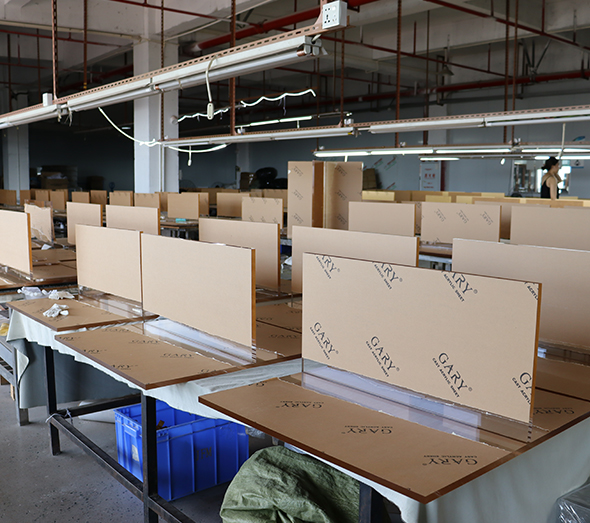
UAE Hospitality Procurement Company — February 2026 — Knock-Down Dining Table
Project: In February 2026, a hospitality procurement company in the United Arab Emirates ordered a knock-down acrylic dining table measuring 1830 × 760 × 760 mm with a 30 mm top and two clear bases. Challenge: the acrylic table had to be assembled after delivery, and both bases needed to fit without new drilling at the site. Solution: JFM used two 160 × 80 × 4 mm stainless interface plates per base, four M8 bolts through Ø9 mm clearance holes, and a 120 × 80 mm hole pattern controlled to ±0.5 mm. Result: both bases fitted the released template, the assembled top stayed within 2 mm of level, and the numbered hardware packs matched the two base positions.
Bulk Production Process
1. Inquiry & Quotation
Share the product specifications, construction, quantity, destination, and required date. We can then confirm the quotation and production schedule.
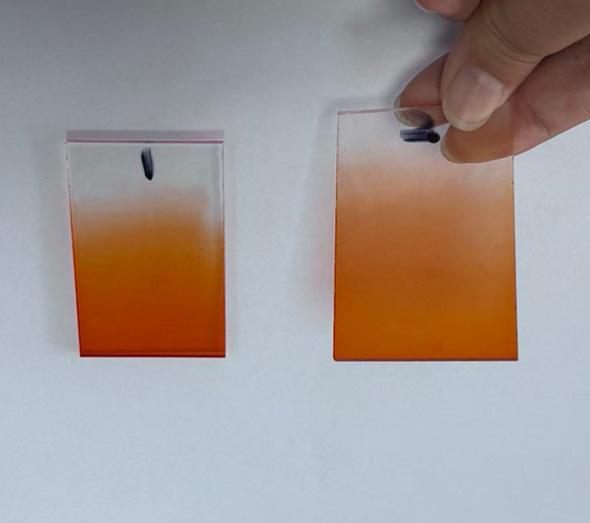
2. Solution Confirmation
We review the structure, materials, finishes, and drawings. We also confirm the inspection scope, packing, and commercial terms before approval.
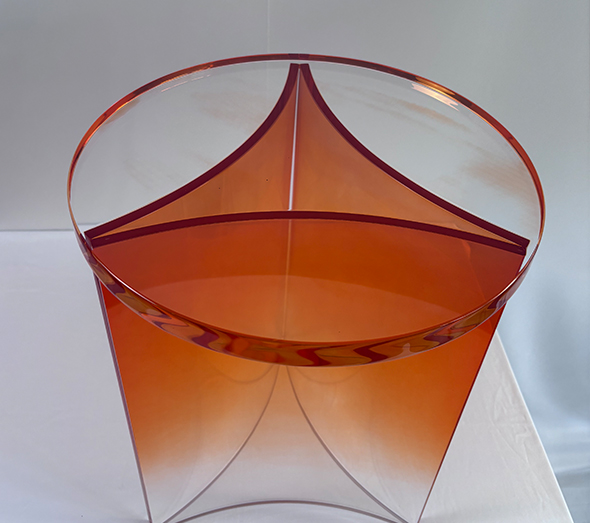
3. Sample Production
The factory produces the approved acrylic table sample and sends it to your team. You can then confirm its appearance, fit, construction, and packing.
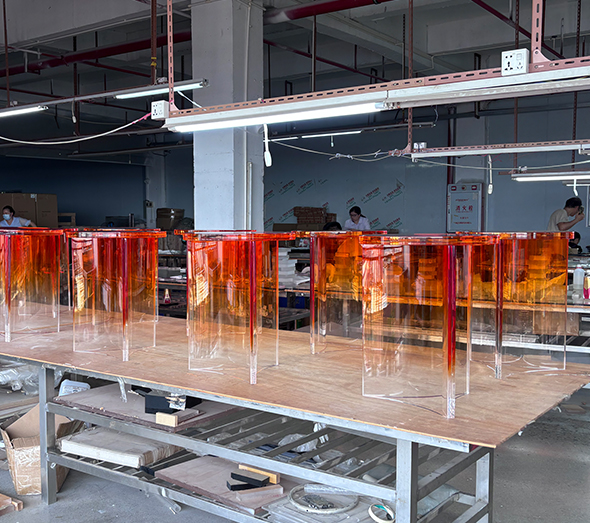
4. Mass Production
After written sample approval, mass production follows the released drawing and specification. Any requested change goes through formal revision control.
5.Products Shipment
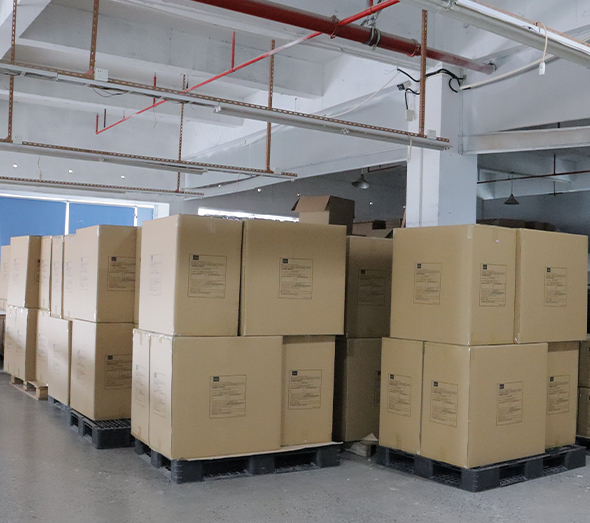
Once production is complete and the balance is settled, we arrange the agreed shipment and provide the relevant shipping documents.
Packing Facts
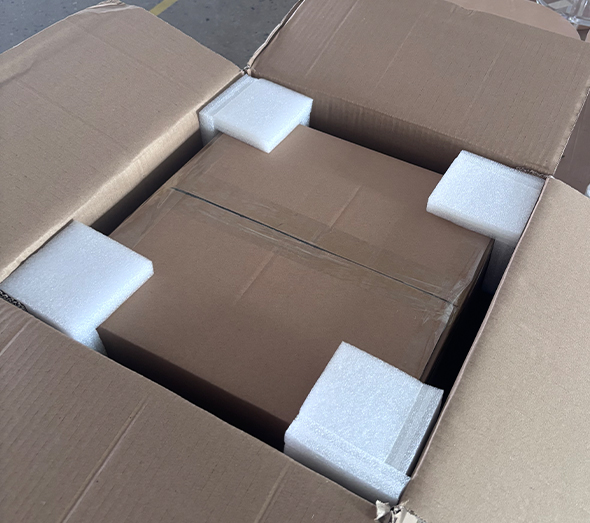
Packaging materials
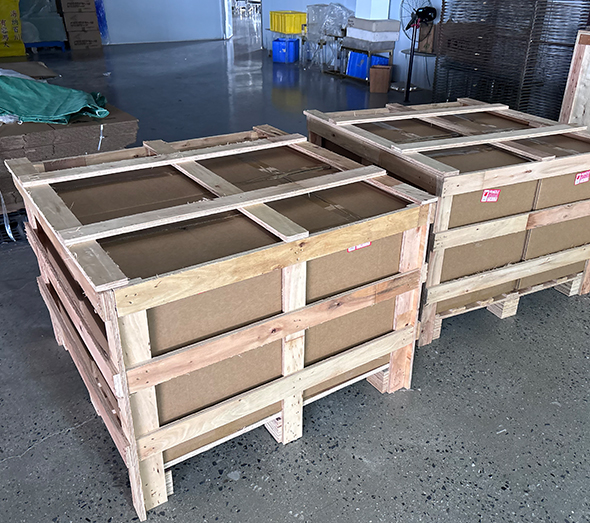
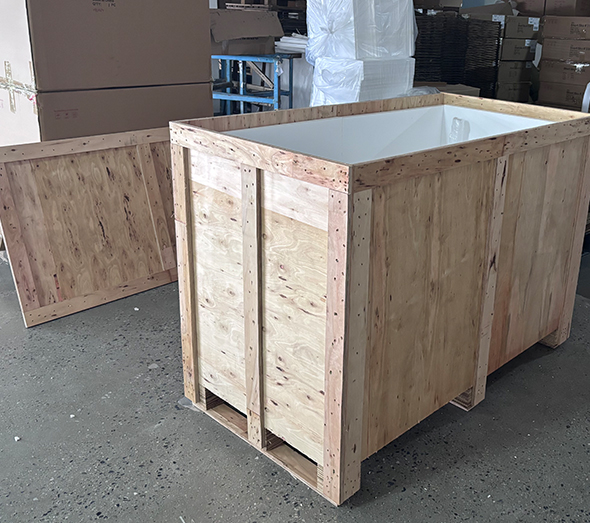
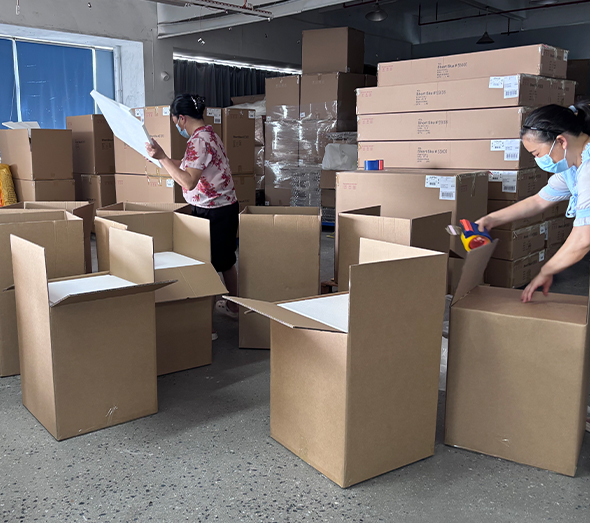
Outer packaging materials:Corrugated Boxes, Honeycomb Boards, Custom Gift Boxes, Wooden box; Cushioning materials:cushioning materials, Air Pillows, EPE, Honeycomb Paper, Kraft Paper Fillers; Sealing and securing materials:BOPP Transparent Tape, Kraft paper tape, Custom Printed Tape, Stretch Film; Special protective materials:Desiccant, Anti-Static Bags……
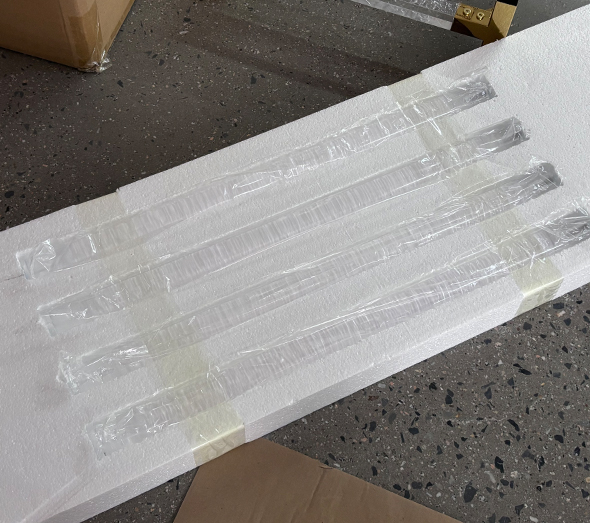
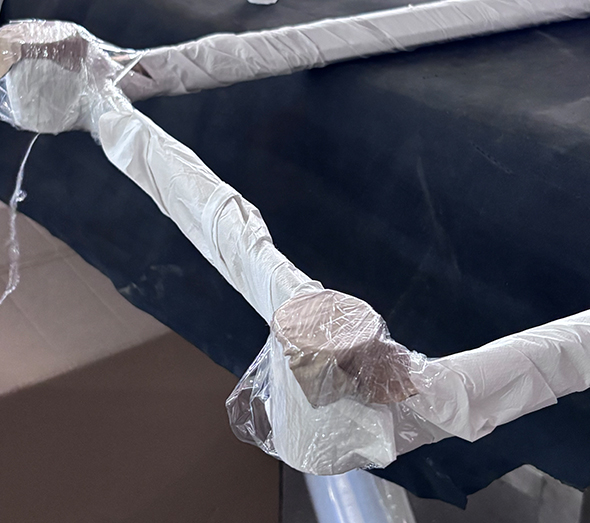
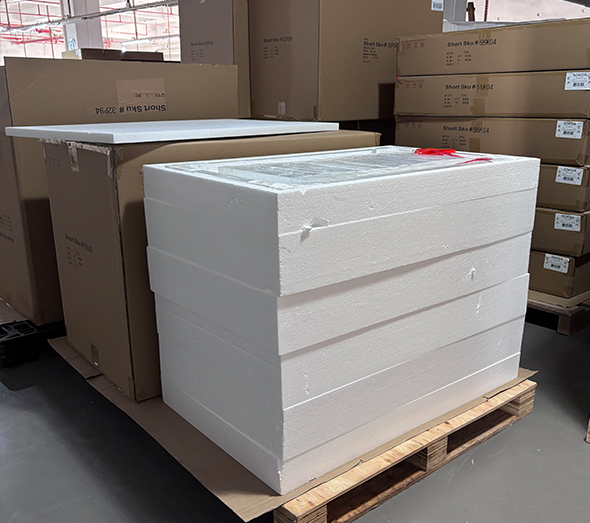
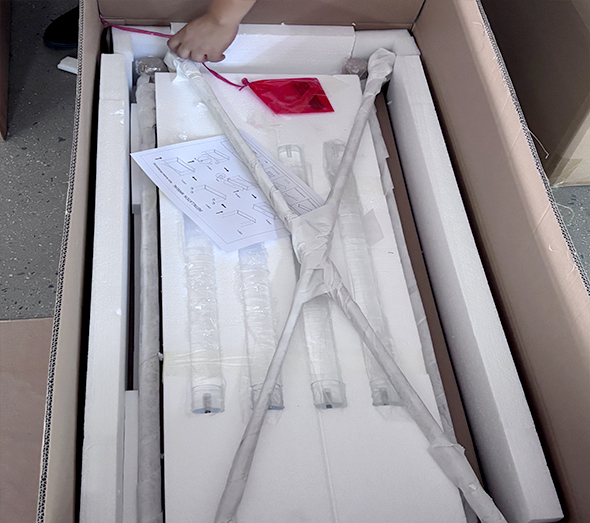
Surface and Edge Protection
A published acrylic-furniture pack uses PE film or bag, pearl-cotton or bubble separation, foam board, wooden case, and pallet to stop surface contact.
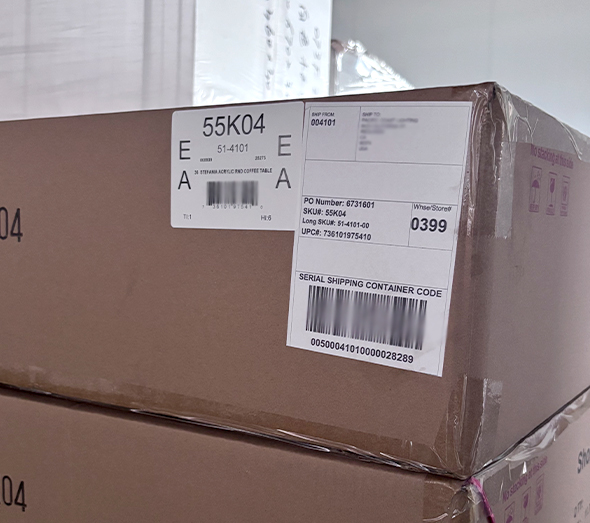
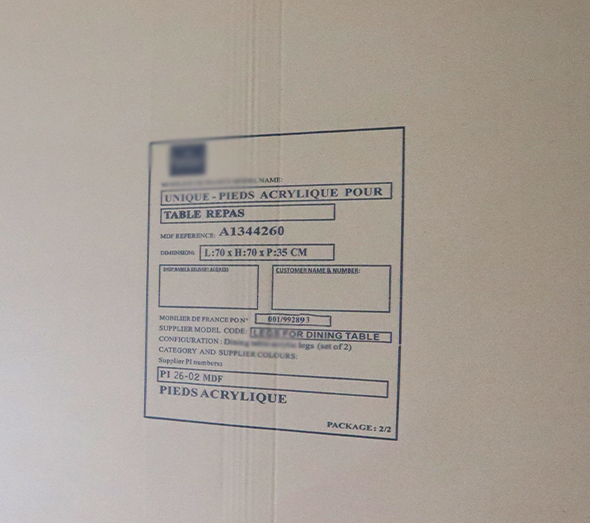
Sets and Carton Identification
Nesting sizes remain separate SKUs. Carton labels list each size, color, pieces per set, quantity, destination, store, room, or project zone.
FAQ
Start with the way the table will actually be used. Note what guests may place on it, how often staff will move it, and whether it stands on carpet or hard flooring. Ask for stability and load information for the exact design, because sheet thickness alone does not answer those questions. Place the sample in a real or mock-up room and let the operations team use it before approving wider installation.
Show the relationship between the table and the seating, not just a list of overall dimensions. Include the tabletop height beside the armrest, the usable surface, and the floor space required. For a C-shaped model, add the clearance beneath the sofa and the reach over the seat. Photographs beside realistically sized furniture and a short measuring guide help customers rule out a poor fit before ordering.
Provide care instructions that match the actual acrylic and finish. Standard uncoated acrylic is usually cleaned with a soft damp cloth, mild soap, and lukewarm water. Dry rubbing, abrasive pads, and unapproved glass cleaners or solvents can damage the surface. Confirm cleaner compatibility when a hotel or commercial team uses disinfectants. Put the same guidance in the carton and the online listing so staff and customers receive one clear routine.
Add storage when there is a clear item that guests or customers need to keep within reach. Test the shelf or drawer with those items and check access from a seated position. On clear acrylic furniture, stored objects remain visible and can quickly look untidy. Compare a furnished storage sample with an open version before extending the range. The useful option should solve a real need without weakening the clean appearance buyers expect.
Use wheels when staff genuinely need to change a layout or move a shared occasional table. Test rolling effort, noise, floor protection, and the locks on the actual flooring, including rug transitions. Check stability with the intended items in place and decide whether the table must be unloaded before moving. If it will stay beside one chair, fixed feet may be simpler and leave fewer parts for the operations team to maintain.
Check the specific record players the table is meant to hold. Their feet, open dust covers, plugs, cable routes, and operating weight can change the usable space. Ask for suitable load information for the proposed table and test playback where normal foot traffic might cause movement. If the design also stores records, assess that weight separately. Publish the verified dimensions and limits so buyers can judge compatibility before purchase.
Begin with a few designs that do different jobs, such as a sofa table, a bedside option, and a storage model. Use sales history or retailer feedback to set the first mix. Test new colors and shapes in smaller quantities before expanding them. Review sell-through, returns, and margin by SKU instead of using total collection sales alone. Replenish proven designs and keep experimental variants at a level the channel can realistically support.
Look at the finished piece in the same conditions your customer will see. Check its proportions beside seating, the edge finish, visible joints, reflections, and the feel of common contact points. Photograph the sample under normal showroom and product-photography lighting. Then compare it with alternatives at the intended selling price. A premium position needs a convincing product experience and presentation; higher material cost on its own is not enough.
Request a Quote for Your Side Table Project
Product Specification
Send your company details, drawing or reference, dimensions, color, intended use, quantity for each design, and destination. For acrylic nesting side tables, include the number of sets and pieces per set.
Destination and Timing
Add the preferred packing method, target arrival date, and whether the order is for wholesale, private label, or an interior project.
Commercial Context
We can then review the sample and bulk quotation on the right basis.